Sea transportation

Container delivery via ports with further handover to a rail or road leg.
Sea + terminal
International Transport Group Transit organizes liquid cargo transportation in flexitanks placed inside a standard 20-foot or 40-foot container. The solution is used for vegetable oils, industrial oils, lecithin, molasses, and chemical liquids after verification of product properties and route requirements.
Calculate Cost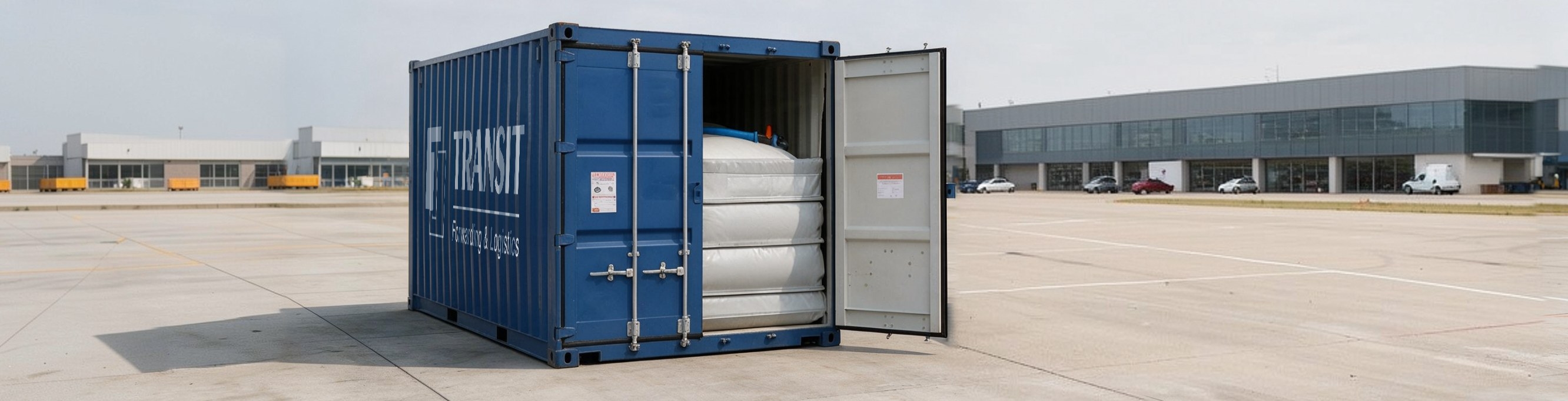
20 or 40 feet
standard container
1
single-use flexitank
A flexitank allows a standard container to be used for non-hazardous liquid cargo without engaging a specialized tank.
The flexitank is installed in a standard 20-foot or 40-foot container, so it can be incorporated into a container logistics chain.
After use, no washing and return operations typical of reusable specialized packaging are required.
No separate fleet of tanks is required; the solution also avoids the rail tariff for tank cars.
The technology provides fast loading and unloading within the agreed arrangement.
We confirm flexitank applicability for a specific product before transportation begins.
| Category | Product examples |
|---|---|
| Vegetable oils | Rapeseed, sunflower, linseed, soybean, and other oils |
| Industrial oils | Industrial, transformer, base, and other non-hazardous oils |
| Chemical products | Liquid chemical cargo after verification of compatibility and transportation requirements |
A standard container with a flexitank can be incorporated into sea, rail, road, and multimodal routes.
Container delivery via ports with further handover to a rail or road leg.
Sea + terminal
Use of a container rail stage on a domestic Russian or international route.
Container rail network
Arrangement of container positioning at the loading point and pickup to the consignee or terminal.
First and last mile
We select the route based on loading and unloading points, container infrastructure availability, and product properties.

Container delivery from an overseas supplier to a Russian consignee or in the reverse direction.
Dispatch of liquid export cargo within a sea, rail, or multimodal arrangement.
Movement between production sites, terminals, and warehouses within container logistics.
Before dispatch, we verify whether a flexitank can be used for the specific product and route.

We agree on product parameters, the flexitank, the container route, and the sequence of operations at the port or terminal.

We confirm flexitank applicability and plan container positioning, loading, transportation, and unloading.

We verify cargo characteristics and transportation requirements, then build a container delivery arrangement.
We obtain information on the product range, volume, properties, and loading and unloading points.
We assess flexitank applicability in a standard container for the specific lot.
We select a sea, rail, road, or multimodal solution.
We coordinate container positioning and the agreed installation and loading operations.
We monitor cargo movement and handover between the agreed stages.
We hand over the container for unloading and completion of the logistics operation.
It is a flexible single-use package with a capacity of 14 to 28 thousand liters, used to transport and store any non-hazardous liquid cargo in universal high-capacity containers.